
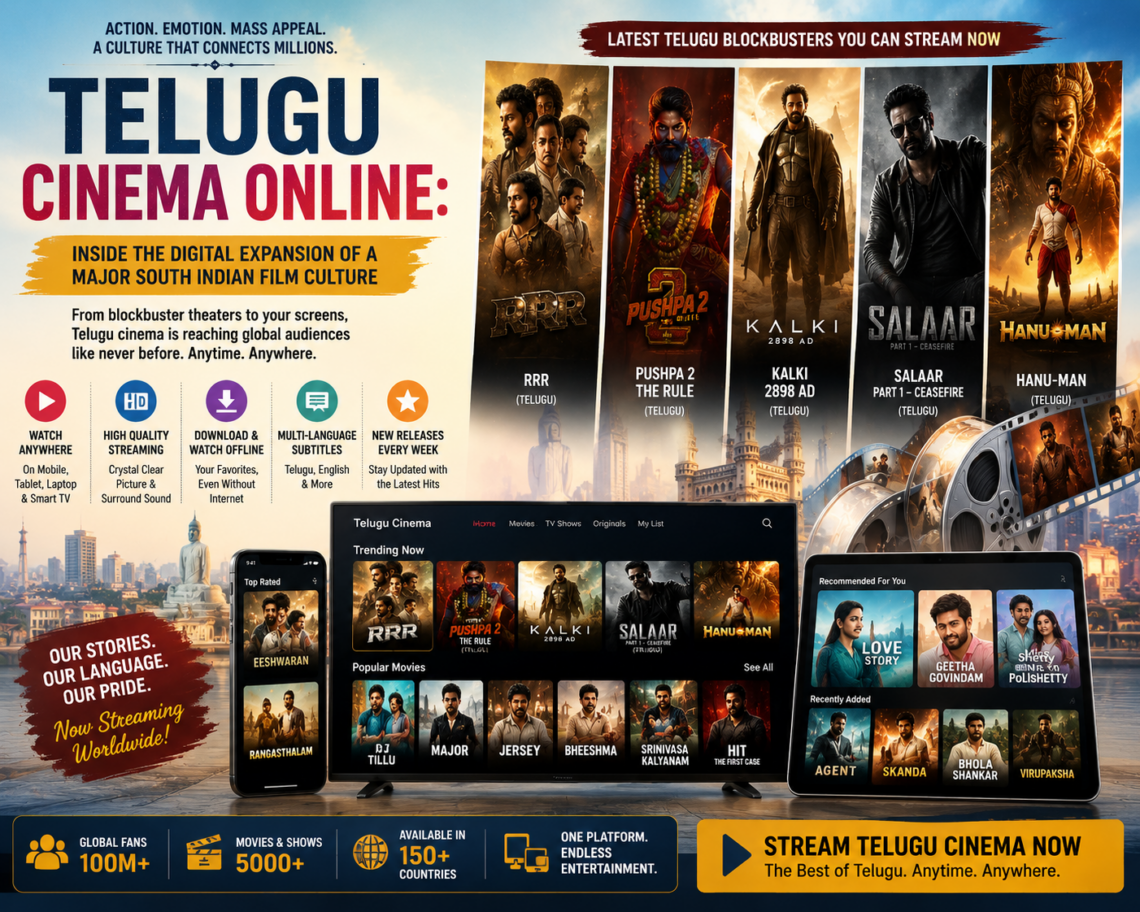
Telugu cinema has become one of the most prominent regional film cultures in India, supported by a passionate domestic audience and an increasingly international following. The industry encompasses mainstream entertainment, action, comedy, romance, drama, family cinema, crime, suspense, fantasy, historical subjects, and experimental approaches to filmmaking. Its growing digital presence has also changed how audiences discover and access Telugu-language entertainment. For viewers interested in তেলেগু মুভি অনলাইন, online catalogs provide a convenient way to explore this broad cinematic world without being restricted to local television schedules or physical media.
Why Telugu Cinema Has Such a Strong Audience
Telugu cinema has developed a distinctive relationship with its audience, particularly in the Indian states where Telugu is widely spoken. Cinema remains deeply integrated into popular culture, while contemporary Telugu productions have also gained visibility beyond their traditional market.
The strength of this audience is reflected in broader cinema-consumption research. An Ormax-based industry report cited by IBEF found that Telugu-speaking audiences were among India’s most frequent moviegoers, averaging more than nine films annually in the study. The same research highlighted the unusually strong cinema-going habits of Telugu and Tamil audiences compared with several other major language groups.
That enthusiasm increasingly exists alongside digital viewing. The rise of online entertainment does not simply replace theatrical cinema; it gives audiences another way to discover and revisit regional productions. For Telugu viewers, this creates a more flexible relationship between the big screen, television, and online catalogs.
A Film Industry With More Than One Identity
Telugu cinema is often associated internationally with large-scale commercial productions, but its catalog is considerably broader. Different periods of filmmaking have produced distinct approaches to drama, comedy, romance, crime, family entertainment, suspense, fantasy, and socially oriented cinema.
This variety becomes particularly valuable in an online environment. A viewer may arrive looking for a familiar genre but discover an entirely different area of Telugu filmmaking through adjacent categories. Digital shelves make these transitions easier because the audience can browse several sections without changing platforms or searching through physical collections.
The scale of the catalog also makes organization essential. When hundreds of titles compete for attention, simply placing them on one page does not create a good discovery experience. Genre categories, curated collections, recent additions, and intuitive search can turn a large archive into something that feels accessible.
For newcomers, this structure can be especially useful. Rather than needing to know individual titles in advance, they can begin with a genre or broad category and gradually develop a sense of the range within Telugu cinema.
Telugu Entertainment Finds a Wider World
The audience for Telugu cinema is no longer defined solely by geography. Telugu-speaking communities outside India have maintained strong connections with regional entertainment, while international audiences have become increasingly curious about Indian-language productions.
The broader digital environment supports this expansion. India’s online media market has grown rapidly, driven by smartphones, affordable connectivity, and the increasing consumption of regional-language content. Industry data published in 2026 indicates that India’s OTT market had reached 1.45 billion monthly active users, while regional-language programming remained an important part of the country’s expanding digital ecosystem.
This matters for Telugu cinema because digital distribution can reduce the importance of physical distance. A viewer living outside Andhra Pradesh or Telangana can still explore Telugu-language entertainment through an internet-connected device. The same principle applies to international viewers who are discovering South Indian cinema for the first time.
Online access therefore becomes part of Telugu cinema’s wider cultural reach, connecting regional production with audiences who may never encounter the same selection through local television.
The Language Advantage in Regional Streaming
One of the most important developments in India’s digital entertainment market is the growing importance of local-language content. Research on India’s internet landscape has shown that Indic-language consumption is widespread, with regional languages such as Telugu playing a significant role in how audiences use digital services.
For Telugu cinema, language is not simply a classification label. It shapes the way audiences experience dialogue, humor, music, cultural references, and regional identity. Digital catalogs that make Telugu-language entertainment easy to find therefore provide a more natural environment for viewers who prefer consuming cinema in their own language.
At the same time, subtitles and multilingual interfaces can help Telugu productions reach audiences outside the language community. This creates a useful balance: the original linguistic identity remains intact while digital accessibility allows the content to travel further.
The result is a cinematic environment where regional language becomes a strength rather than a distribution limitation.
Music, Visual Scale and the Telugu Screen
Music occupies an important place in Telugu popular cinema, while visual scale has also become a recognizable part of the industry’s contemporary identity. Large production environments, detailed cinematography, choreography, elaborate sound design, and modern visual effects can all contribute to the presentation of Telugu entertainment.
Digital playback therefore needs to preserve more than basic picture quality. High-quality audio and video can make a meaningful difference when audiences are watching productions designed for strong audiovisual presentation.
This is another reason why a well-built online catalog should not be treated merely as a database of files. The quality of the interface, the speed of access, and the reliability of playback all contribute to how comfortably audiences experience the cinema itself.
When the technical environment works properly, the viewer can move from a catalog shelf to a full-screen presentation without having to think about the infrastructure behind the transition.
How Digital Catalogs Change Movie Discovery
Traditional movie discovery has often depended on television programming, theatrical advertising, newspaper coverage, word of mouth, and physical collections. Digital platforms add an entirely different layer to that process. Search tools, genre shelves, curated collections, recent additions, and personalized discovery can all influence what audiences encounter.
This is especially useful for Telugu cinema because the catalog can contain productions from many different periods and genres. A viewer searching for one specific type of entertainment can narrow the selection, while someone browsing casually can allow the catalog to suggest new directions.
India’s entertainment market is increasingly becoming a multi-screen ecosystem in which audiences influence not only what they watch but also when and where they watch it. Recent industry analysis describes this shift as a hybrid video environment spanning television, connected TVs, mobile devices, and digital platforms.
For Telugu audiences, this means online discovery can complement theatrical habits rather than simply replacing them.
A Direct Route From Shelf to Playback
The usability of a streaming platform becomes especially important when audiences are browsing a large regional catalog. A viewer should not have to pass through multiple registration screens or promotional interruptions before finding out whether a particular title is worth watching.
Moviewala’s frictionless model keeps the interaction direct. Viewers can explore the Telugu selection, choose a title from the digital shelf, and move toward playback without a mandatory sign-up wall. The absence of annoying pop-ups also helps preserve a clean environment in which the catalog remains the main focus.
One-click access matters because browsing is often exploratory. A viewer may open one category, examine several titles, return to the shelf, and choose something else. When every transition is simple, the catalog feels more like a digital cinema collection than a complicated web interface.
This simplicity also makes the service more approachable for international viewers who may be discovering Telugu cinema without already knowing the catalog.
Telugu Movies Across the Screens People Use
The modern Telugu audience can choose from a wide range of viewing environments. Smart TVs provide a natural setting for home cinema, while laptops and desktop computers offer flexibility. Tablets and smartphones make regional entertainment available in more portable situations.
The growth of connected television is particularly significant in India. Ormax research cited by IBEF estimated that India’s active connected-TV base reached 129.2 million users in 2025, representing a major increase from the previous year.
This creates an environment where Telugu cinema can move naturally between large and small screens. A viewer may browse on a smartphone and later choose a Smart TV, while another may use a laptop as the primary viewing device.
For the platform, this requires responsive navigation and adaptable playback. The catalog should remain recognizable regardless of screen size, while controls and content shelves need to remain easy to use.
The Infrastructure Behind Stable Streaming
High-quality online cinema depends on a sophisticated technical layer. Cloud infrastructure, distributed content delivery networks, efficient compression, and adaptive streaming technologies work together to transmit large audiovisual files across different networks.
Compression helps balance detailed video with manageable data requirements, while adaptive playback can respond when connection quality changes. Distributed delivery systems can improve responsiveness by placing content closer to audiences in different geographical regions.
These technologies become particularly important for a Telugu catalog with an international audience. Viewers may connect from India, the Gulf, Southeast Asia, Europe, North America, or elsewhere, using different devices and internet providers.
The technical objective remains simple: the viewer should be able to select a title and experience stable, high-quality playback without having to understand how the delivery system works.
A Regional Industry With Global Momentum
The international growth of Indian-language entertainment provides an important context for Telugu cinema. Indian films and series recorded 688 million global views on Netflix during the first half of 2026, according to reporting based on Netflix’s latest viewing data. The same report highlighted the growing international performance of South Indian content, reinforcing the wider global interest in regional Indian filmmaking.
This broader international interest creates opportunities for Telugu cinema to reach audiences beyond its traditional markets. Digital distribution allows regional productions to participate in a global entertainment environment where language-specific content can find audiences through discovery systems that were not available in the era of physical media.
For Telugu filmmakers and audiences alike, this means regional cinema can retain its linguistic identity while gaining greater international visibility. The digital catalog becomes a bridge rather than a boundary.
The Next Phase of Telugu Cinema Online
The future of Telugu online entertainment will likely be shaped by continued improvements in connectivity, mobile access, connected television, video compression, multilingual interfaces, and catalog discovery. As India’s digital audience continues expanding, regional-language entertainment is positioned to remain an important part of the country’s streaming landscape.
For audiences, the most meaningful development is greater control. They can explore genres according to their interests, choose between different screens, return to the catalog when convenient, and move from discovery to playback without the restrictions associated with traditional programming.
The experience can remain deliberately uncomplicated. Open the Moviewala Bengali catalog, explore the Telugu movie section, browse the available shelves, select a title, and press play. With high-quality playback, direct one-click access, no registration wall, and no distracting pop-ups, the technology can remain quietly in the background while the breadth of Telugu cinema stays at the center of the viewing experience.

